
Aura & Transvestment
Aura & Transvestment consists of a series of non-fungible tokenized images based on public domain photographs of various western paintings created between 1900 and 1935 that have been visually transformed through simple, yet resource intensive algorithms. When purchased, each token gives you access to a high resolution original that contains the key to a corresponding video-essay designed for individual consumption in mobile devices.
Through storytelling, the work explains its own mechanics. By describing its own powers and contradictions it explores notions of value, ownership, artificial scarcity and abundance in the digital realm. The essay is a marxist analysis of the commodification of digital art taking Walter Benjamin’s concept of aura as a starting point. It argues that, for non-fungible tokenized digital art, cryptography serves as an artificial source of auratic power that reverts the political potential of reproducibility falling back to a new form of magical notion of aura. In this case the ritual performed is that of property and ownership. Finally, the essay proposes transvestment as a temporary counter-action for the expropriation of value from capitalist forms of production and into new models of social coordination that aim for the total de-commodification of art.
The price of each final non-fungible token reflects the amount of computing power used to generate it’s variation. Reflecting on the emphasis and almost fetish with computation power and proof of work in the blockchain community.
As an act of transvestment, most of the profit acquired for the selling of the artworks will be donated to a voluntarily run Hackerspace in Mexico City working in favour of free software and open access.



Blockchains as the first implementation of a decentralized form of artificial scarcity foretell the possibility of a future where distributed ledger technologies liberate humans from nation-state monetary policy and centralized fiat currencies. Unnecessary bankers, bureaucrats, lawyers or other forms of centralized, corruptible authority will be minimized by software, agency and interface. The immutability provided by a consensus algorithm declares freedom by default. In this new sovereign era “Code is law”.
But luring underneath the y(earnings) of freedom, the entrepreneurial ethos has systematically served Capital by precarizing labour, eroding democracy, exploiting identity and denying privacy. From the eyes of eager investors and crypto-bros, every digital interaction can now be coded as a transaction, every asset tokenized, every click monetized and every word recorded on an immutable ledger, forever.
In her essay The Revolution Will (Not) Be Decentralised: Blockchains Rachel O'Dwyer writes:
If we design distributed ledgers following the values and processes of ‘methodological individualism,’ then we also end up generalizing and socially reproducing these neoliberal mechanisms.
“What kinds of subjectivity do we want to algorithmically inscribe into our systems?“
But the smart contract does not restrict the possibility of others downloading a copy or making screenshots of the digital object. What is being sold is not the file itself but a provable claim of ownership towards it; A private key pointing to a file which allows the holder to display their assets on a platform and ultimately sell this access to others at a determined price. At its core, the whole ecosystem revolves around the imposition of property rights and the existence of platforms and marketplaces where those claims are displayed and performed.
For these digital files, cryptography serves as an artificial source of auratic power that rejects the potential for reproducibility by imposing a form of aura rooted in the properties of physical works. Monetary value emerges as a consequence of artificial scarcity.
With this action aura is reverted to be the service of the ritual. Resembling those of a magical or religious kind, this is a ritual driven by a desire for authenticity and a mystification of ownership. Non-fungible tokens perform the neoliberal mechanisms of capitalist forms of production on the altar of market-platforms
As a contrast, in his 2019 essay, which references Walter Benjamin’s original title. Mihalis Pichler writes:
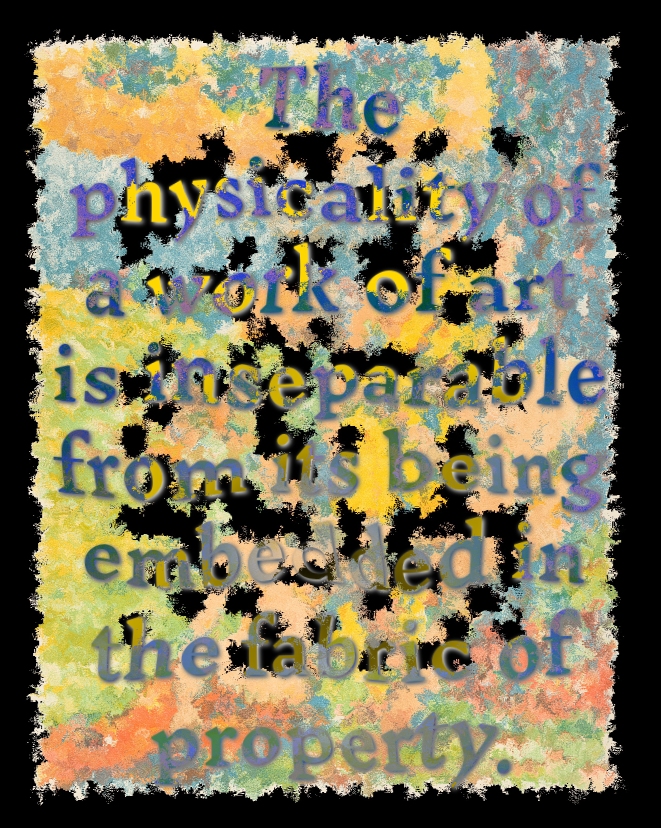
The physicality of a work of art is inseparable from its being embedded in the fabric of property. …for the first time in world history, digital reproduction emancipates the work of art from its parasitical dependence on ownership.
…to ask for the “authentic” copy makes no sense. But the instant the criterion of limitation ceases to be applicable to artistic production the total function of art is reversed. Instead of being based on ownership, it begins to be based on another practice – everyday life.
The crypto-collectibles are in fact the crypto-commodities: financial assets to be owned, sold, traded and speculated upon.
Why claim ownership over the intangible? Why conjure a market into existence through the illusion of authenticity? Why build platforms, communities and infrastructure around enforcing property rights?
In the best of cases, this may be a way of remunerating digital artists while participating in a fun online marketplace. Artists making a livelihood out of their work is always positive.
But, is this really what we want? To willingly carry the weight of physical matter? to knowingly emulate the unfair structures of capitalist markets? To surrender the infinite power of abundance in favor of commodity fetishism?
By commodifying the digital files one is declaring the final artistic product as the bearer of value, thus obscuring the social relations of the production of the work. Does an artwork only assert its value at the moment of an effective purchase? How is the price of a work of art relevant to its individual appreciation? Where does the value actually come from?
The value of an artwork, subjective in essence, emerges at the encounter of the piece and the personal experience of the spectator. It is realized in a sublime moment that might last seconds and reverbatate for a lifetime. The value of an artwork can only increase when it encounters a broader group of people in an expansive set of possible circumstances. To continue to subject art creation to the whims of capitalist markets will only lead us to scarcity, rivalry, conformity and advertisement.
Crypto-collectibles serve only as a metaphor to reflect upon a broader issue: the obsession for possession. It is through these technological implementations and social mechanisms that the delusion of property is perpetuated. The future they envision is that of absolute commodification.
But then, how to economically remunerate artists? Rent and food will not be paid by the sublime experience of the spectator…
Monetary gain should be seen as a vehicle for life sustenance, not as bearer of value. The focus should be on supporting the capacity to produce art. In other words, the value is not in the work of art but in the art of work. By liberating the artworks from the price system, digital artists would be able to create in a less constrained environment, with head room for
creative risk, care work, sharing and collaboration.
While substantially better, conforming labor to commodification should not be the final answer, but a step towards total de-commodification. A radical transformation of ownership for the art objects, the art producer’s time and everything in between. Ultimately, by decommodifying the subjective, value would be correctly allocated in the realm of the immeasurable, the invaluable and the unquantifiable.
How does this future look like? Perhaps as non-rivalrous forms of art making financially supported by federated networks, solidarity-based patrons, Distributed Cooperative Organizations, anti-copyright funds and decentralized institutions.
As more forms of revolutionary organization continue to pop-up, systems that support them must be established. Transvestment acts as a form of direct action for the expropriation of value from capitalist forms of production and into new models of social coordination. By strategically participating in the capitalist market economy, projects may acquire capital that can be redirected towards emancipatory purposes.
In his book: 99 thesis on the revaluation of value, Brian Massumi writes:
Even before capitalism is overcome, it may be possible to have one foot in both streams, in ways that prefigure its beyond. In that beyond, quantification would be beholden to surplus-value of life, rather than surplus value of life being slave to accumulation.