

Prometheus Bound
2.4 to 2.5 billion years ago, cyanobacteria committed the original Promethean act – igniting the fateful torch – by developing the ability to split water using light, unleashing oxygen and forever altering our planet and making our existence possible. Now we chain the algae as Prometheus was chained to his rock, trying to extract that same energy from them. Are we thereby trying to be the next mythological Prometheus – harnessing and breeding algae strains to steal fire from nature – or are we merely in the position of Mary Shelley’s Prometheus from Frankenstein; or, The Modern Prometheus? Like Frankenstein, who reached beyond human limits, trying to overcome his own insufficiency, we turn to ever new technologies in search of a technological fix for our fundamental problem: we need more energy, more fire.


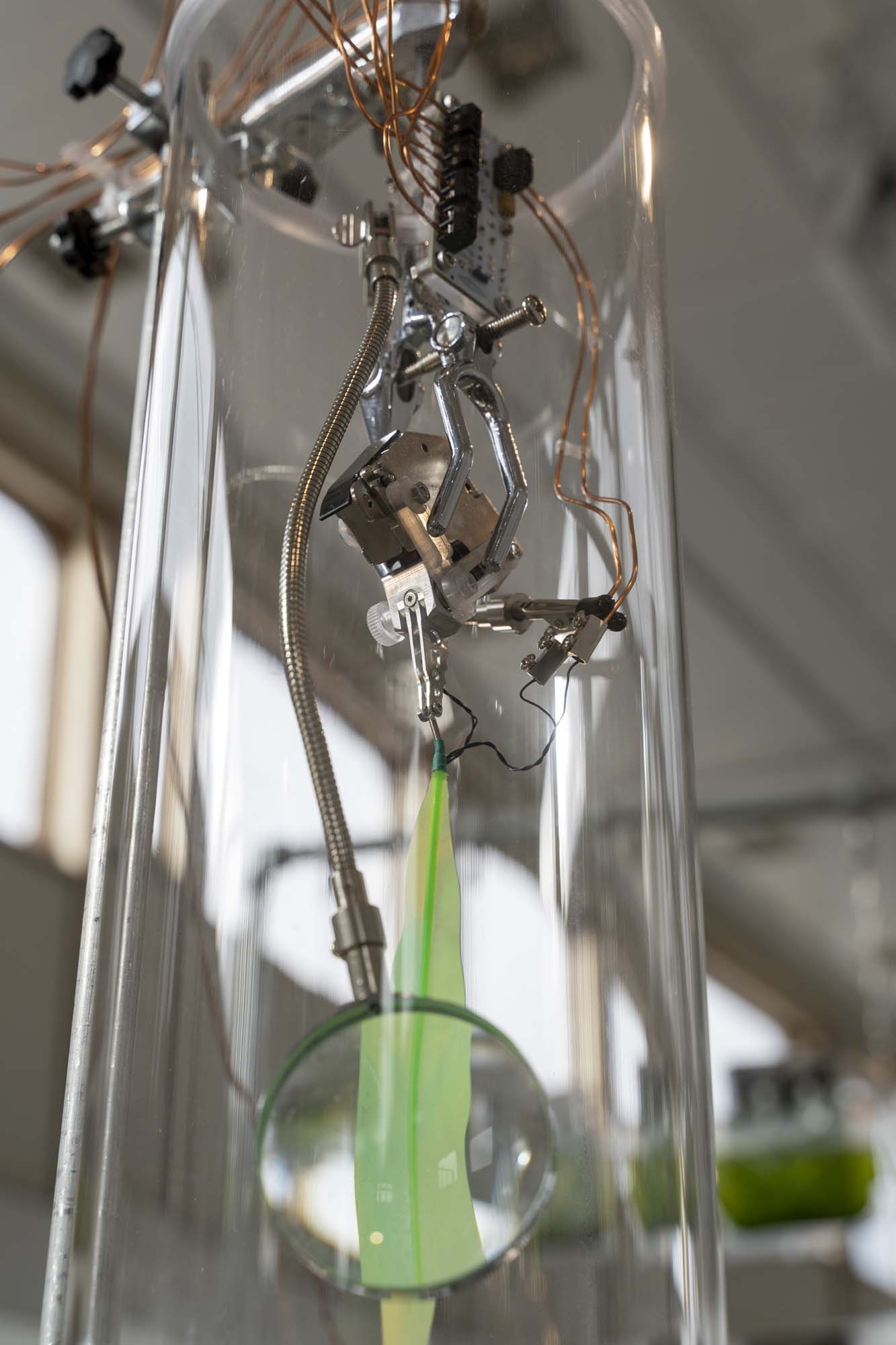
The work Prometheus Bound was presented on the MS Dauerwelle, comprising two contrasting components. In the futuristic installation part, 60 biophotovoltaic cells containing local diatoms, green algae, and cyanobacteria were harnessed to generate electricity – barely enough to move an artificial macroalga, bringing it “to life.” In the second part at the rear of the ship, the preceding year of artistic research was presented in the form of the shelf used throughout the experiments: growing algae, testing biophotovoltaic cells, logging live data, and video footage of microscopic organisms. The work traces the distance between the promise of a new and clean energy source and the messy reality of working with living organisms. Through the DIY cultivation of algae and the laborious attempt to harvest electricity released during photosynthesis, questions emerge not only about viability but also control, care, and the ethics of instrumentalizing other species.
This DIY process proved far more difficult than anticipated. Cultivating algae without external energy inputs like pumps, lights, and nutrition was barely feasible; an only partially controlled environment meant predators and other unwanted organisms entered the system without sterile control or a balanced ecosystem to keep things in check. The energy yields were minimal – and in the exhibition setting, the energy required to heat, illuminate, and sustain the living algae ironically far exceeded the power extracted from them. My cells produced between 0.08V at 50µA (0.000004W) and up to 0.2V at 200µA under best conditions. In the isntallation, the cells were connected through a combination of series and parallel wiring to a custom PCB featuring an LTC3108 harvesting chip. In rare, ideal condtions, this setup slowly accumulated the trickle of energy into a tiny 100µF capacitor, which, once fully charged, discharged into a small actuator to move the artificial alga.
In the accompanying written part of my thesis, I trace and document in detail these challenges and the idealization of supposedly green technologies, in particular biophotovoltaics. The first chapter follows my attempts to cultivate perfectly green algae, before expanding outward to interrogate the cultural weight of the color green: from the toxic beauty of harmful algal blooms to plastic moss walls in shopping centers and algae houses, analyzing what desires and blind spots we encode into the color when we reach for it as a shorthand for nature and sustainability. This tension is also reflected in the exhibition itself.
The thesis further examines our ever-growing energy demands and the dream of freely abundant, consequence-free energy – almost a perpetual motion machine – and the technological fixes this dream produces. A trap I found myself increasingly falling into: spending more and more effort and resources trying to optimize my cells and make them work, rather than questioning the structural assumptions underlying the whole endeavor.
What emerges instead is a call to question our perspective on energy: not to find yet another source or fix to feed an ever-growing demand, but to recognize that the real problem lies in the scale of that demand itself. As long as any energy gain is immediately consumed by new growth, nothing will be enough. The path forward is not a greener fix, but a shift toward polycultures, re-discoveries, resonance, systemic thinking, and a move from Umwelten (around-worlds) towards shared Mitwelten (with-worlds).
The thesis is available on request
Mail:
mastodon: @namenroh @tldr.nettime.org
Impressions from the opening of the exhibition
During the research I could observe a manifold world of organisms.

Diatoms and Green algae under the microscope. The informal term “algae,” from the Latin alga (seaweed), encompasses an assemblage of photosynthetic organisms. They range from unicellular microalgae – some smaller than a micrometer – such as cyanobacteria, which are in fact not algae but prokaryotes lacking a nucleus and are informally known as blue-green algae, to bigger green algae and diatoms, and up to large multicellular macroalgae species such as Ulva or Kelp that can grow several meters long.

Close up of different cultures in the research shelf

Close up of the data-logging in the research shelf

The design of my biophotovoltaic cells

Close-up of a DIY algae reactor, used later as the background for the exhibition poster.