

Space Odradek: Dive into the Spooky Invisible
Zombie satellites are decommissioned, inactive satellites that unexpectedly resume operation and begin transmitting signals back to Earth. While official space agencies classify these objects as space debris, amateur enthusiasts have dubbed them “zombies” due to their intermittent signaling and half-dead nature—being electronically active yet functionally dead. By drifting beyond human intent and control, these satellites acquire a strange independence and uniqueness, existing as entities that are forgotten yet undeniably real. This object allows one to contemplate the meaning of things situated in a liminal zone between functional death and physical reality, serving as a reflection of the self in a modern society where existential status is determined solely by productivity and utility. Ultimately, zombie satellites challenge the dominant classification system that strips the status of existence based on operation and efficiency, applying the same rigid logic to both humans and objects.
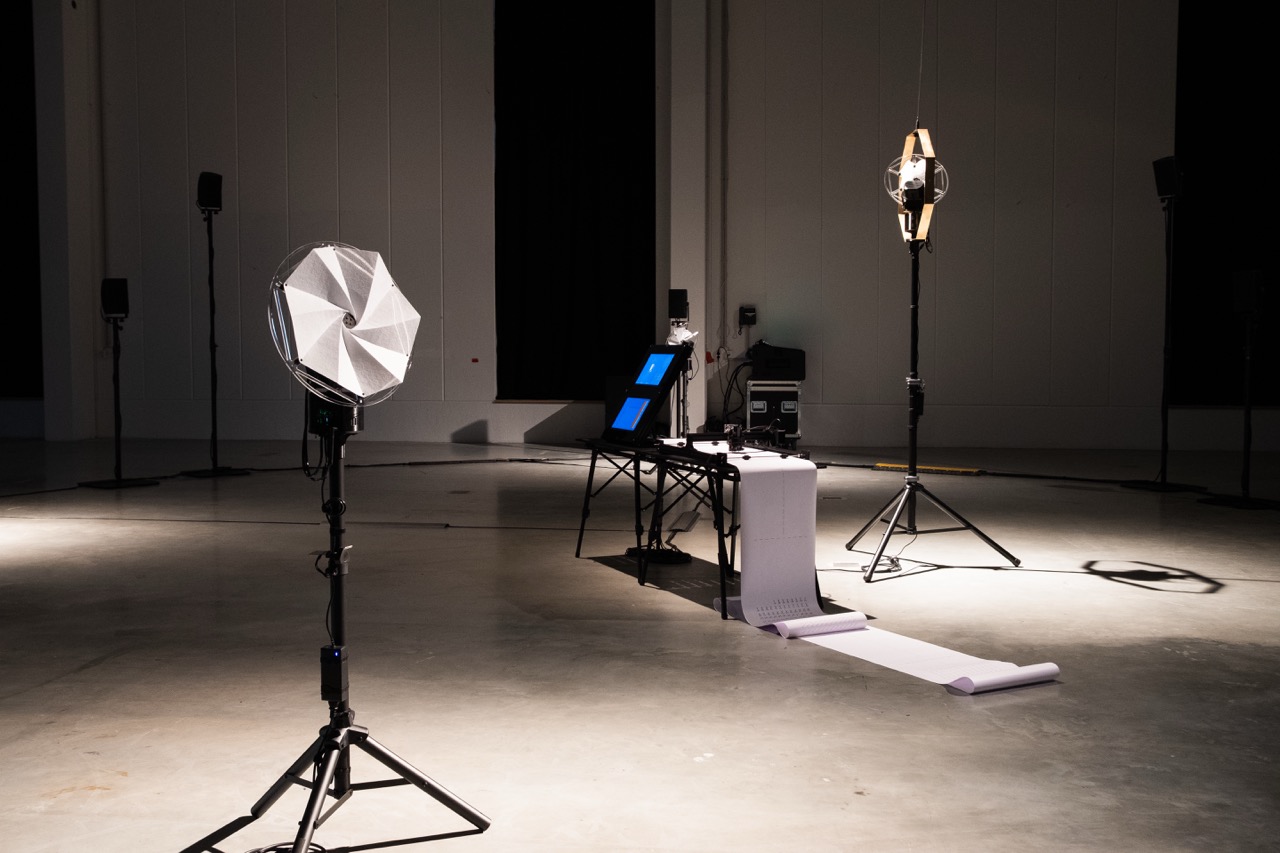
The name “Odradek” was adopted as a metaphor for zombie satellites, which escape human control and understanding once they lose their intended functionality. Unlike typical technological artifacts defined strictly by utility and precision, a defunct satellite orbiting to its own rhythm resists replacement and emerges as an autonomous, unclassifiable other.
“Anything that dies has had some kind of aim in life, some kind of activity, which has worn out; but that does not apply to Odradek.” – Franz Kafka, The Cares of a Family Man
Much like the enigmatic entity from Kafka’s story—whose origin, purpose, and form remain ambiguous—the true reality of a zombie satellite becomes physically unreachable and conceptually ungraspable. Therefore, the project utilizes the name Space Odradek to reinterpret these discarded remnants, questioning the boundaries between utility and existence, and creating a speculative rendezvous point where the ungraspable entities on the Earth orbit meet terrestrial artistic apparatuses.
Upon this context, the project Space Odradek explores zombie satellites—defunct satellites that continue to transmit signals—and abandoned space objects, questioning whether things that have lost their purpose are truly dead or can emerge as new forms of existence. It seeks to reinterpret the remnants of technological civilization as artistic apparatuses, raising questions about the boundaries between usefulness and uselessness.
Furthermore, by introducing a speculation about a fictional space archaeologist obsessed with unidentified satellite signals, the project transforms the exhibition space into a site where reality and fiction intersect. Combined with mechanical performances, this narrative device allows the audience to sensorially encounter and experience the spectral traces left by technology.

This apparatus receives and decodes signals from zombie satellites, manifesting them through sound installations and mechanical performances integrated with visual elements to create an immersive experiential space where visitors sensorially experience the haunting presence of zombie satellites. The sound system operates through three channels, broadcasting real-time signals alongside recorded data from other tracked satellites through spatial audio to form a multi-layered soundscape.


The installation utilizes a digital display interface and a physical plotter to visualize the real-time presence of tracked satellites. The display graphically maps the satellite’s real-time orbital positions, azimuths, and trajectories using a blue and white aesthetic that pays homage to the 1960s space agencies that launched numerous zombie satellites, including the narrative’s central object, TRANSIT 5B-5.
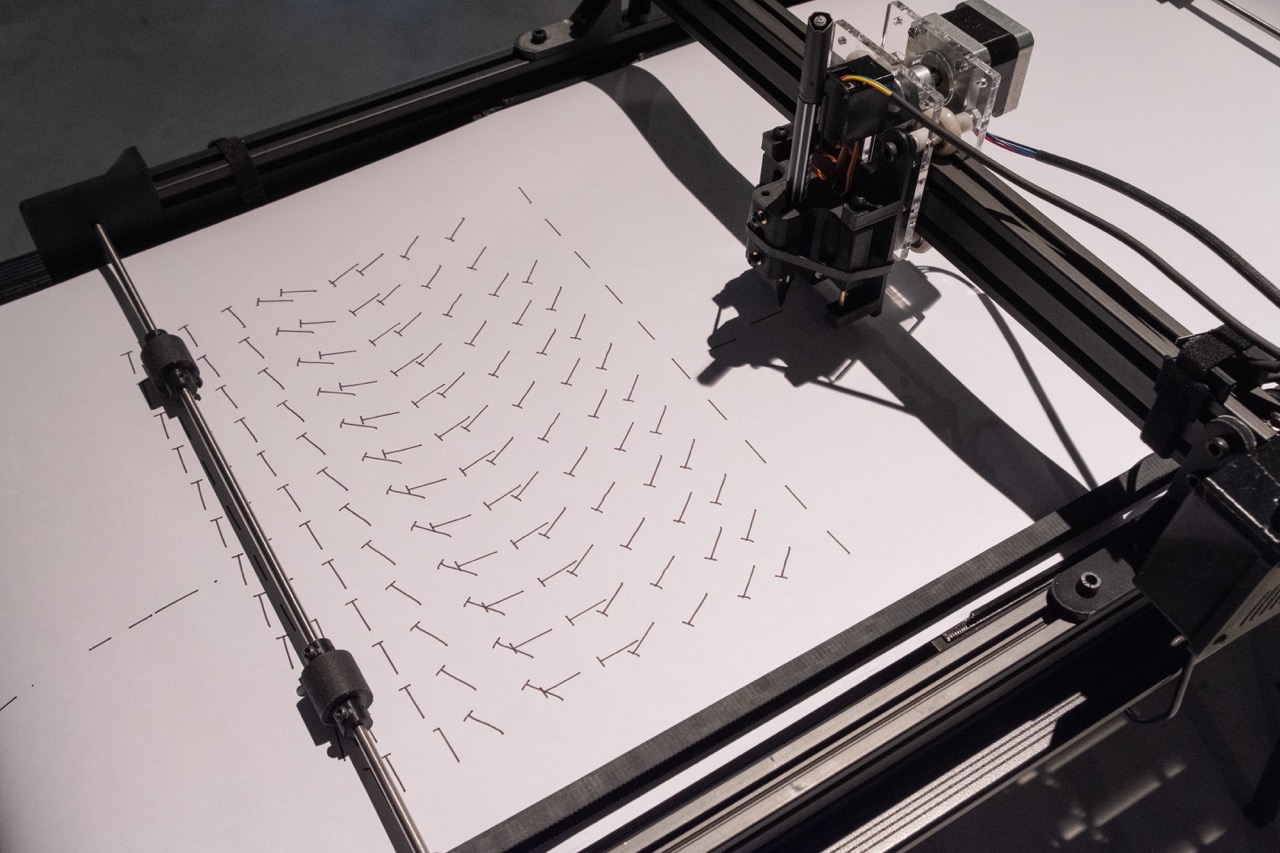

Complementing this digital tracking, the plotter translates real-time satellite signals into geometric shapes on a continuously moving paper scroll. By recording the invisible status of these celestial objects as tangible physical traces over time, the plotter’s drawing mechanism materializes the project’s speculative narrative. This semantic function is particularly pronounced when TRANSIT 5B-5 is detected; as the satellite reaches its zenith and the signal strength maximizes, the plotter draws atypical, increasingly distorted quadrilaterals that visually embody the mysterious anomaly of the satellite.

Also, a fiction in the form of a government report provided at the exhibition hall transforms the physical space into a site where a fictional space archaeologist underwent a mysterious experience. This narrative device blurs the boundaries between fiction and reality, situating the audience within a speculative scenario and strengthening the narrative immersion in the extraordinary experience of encountering zombie satellites.


The Odradek functions as a mechanical performance apparatus semantically linked to the zombie satellites drifting above. When a registered satellite appears in the sky above the exhibition hall, the central system aligns the device’s orientation with the satellite’s trajectory. By modulating the expansion and contraction of its folding membrane in proportion to the satellite’s real-time velocity, its distance from the gallery, and the intensity of the received signal, the apparatus attempts a form of semantic communion while providing the audience with intuitive visual clues of this interaction. If multiple satellites appear simultaneously, the system divides the Odradeks into up to three groups to track different targets, and this tracking motion continues until the respective satellites disappear below the horizon and completely leave the sky above the hall.
“It is only the kind of laughter that has no lungs behind it. It sounds rather like the rustling of fallen leaves.”
– Franz Kafka, The Cares of a Family Man

The sound implementation of the project tracks 14 zombie satellites, outputting unfiltered, real-time live signals when a satellite appears alone, or forming three-dimensional acoustic layers with pre-recorded signals when multiple appear simultaneously. This core principle of playing actual signals ensures the audience perceives the auditory experience as a physical event occurring on the Earth orbit, transforming the exhibition into a site of a real encounter. Aesthetically connected to Kafka’s description of Odradek’s “laughter that has no lungs,” the atypical sound intertwines the noise of vast space and mechanical signals rather than refined melodies. This unfiltered sound texture allows the audience to confront the voice of an untranslatable ‘Non-human Entity,’ auditorily maximizing the bizarre presence of abandoned objects and completing the project’s speculative narrative.
ZER01NE DAY Exhibition

First developed in September 2024, the work made its debut at the Zero1ne Festival in Seoul in September 2025, the work frequently prompted audiences to question whether zombie satellites actually exist and if the sounds they heard were real. Because most people perceive space technology as a realm of ultimate precision and absolute control, the existence of uncontrollable zombie satellites scattering signals freely back to Earth served as an anomaly that challenged their conventional understanding. However, as visitors realized that cutting-edge human scientific achievement does not guarantee total comprehension or control over our artificial environments, their astonishment at these ghostly entities drifting through the void transformed their engagement with the work from mere curiosity into deeper existential contemplation.
Colloquium event


In the exhibition and colloquium held at Speicher XI A, Halle 1 from April 10 to 13, 2026, the number of Odradek units in the installation was scaled down but shifted its primary focus from mechanical demonstration to fully conveying the project’s speculative narrative. This shift was realized through two major additions: a plotter that outputs satellite signals onto paper, and a short story that establishes the speculative background. By moving or reproducing the specific devices handled by the fiction’s protagonist directly into the gallery, the physical installation functioned as a medium to visualize the narrative, specifically emphasizing the recreation of the exact visual and auditory sensations the character experienced upon contacting the unknown zombie satellite.
Credits
- Chihim Chik (Sound design and engineering),
- Boeun Kim (Co-Curation, Production, Coordination)
This project was created with the support and sponsorship of Zer01ne
Exhibition
ZER01NE DAY (17. Sep – 21. Sep. 2025, Hyundai Seongsu Hub, Seoul)
Photography by ZER01NE, Sangbong Lee
Video by Deokman Kim
Colloquium
Theses Exhibition (10. Apr – 13. Apr. 2026, Halle 1 / Speicher Xi A, Bremen)
Photography and Video by Sangbong Lee