

Pocas

Pocas (pocas.store) is a research project at the intersection of distributed computing and alternative economies. It is inspired by centuries of self-governance, mutual aid and self-organization, as well as decades of free software, p2p networks, cryptography & distributed ledgers. Pocas investigates how recent advancements in distributed computing make old and new mutualist economic practices viable, efficient and convenient. In the process, it maps the existing organizations, practices and technologies that could make this a reality today.
As a manifestation of this research, pocas uses economic science-fiction to imagine the culture and systems of a network of autonomous mutualist spaces set in an alternative version of contemporary Mexico City. In this pluriverse, organized communities utilize social and digital technologies to coordinate and cover their needs in collaborative ways. pocas appropriates the affects of speed, virality and efficiency of the ubiquitous capitalist self-service convenience store model to propose a mutualist mutation of convenience. By leveraging distributed computation and cryptography, pocas speculates systems that scale the coordination of mutual aid, solidarity and local economies to provide a competitive alternative to capitalism. By rendering this world possible today, and charting a viable path, pocas seeks to join the existing struggles for the reappropriation of the collective means of self-sustenance.

Multiple elements of the pocas pluriverse

Diversity of offerings available under mutualist convenience
In pocas, each store is unique, responding to its local needs and desires. Through protocolitos (tiny protocols) people self-organize to fulfill their needs. Groups can easily start community kitchens, electronic repair workshops, water filtering systems, natural detergent production, skill sharing circles and many others. In this speculation, a mesh network provides local connectivity without the internet. Decentralized delivery networks of DIY self-driving cargo bikes move goods around the city. Local working groups develop open-source natural medicine. People trade services using mutual credit and swapping stake in each other’s projects. Federated communal funds offer postcapitalist financial services. Communities decommodify the products they use the most. In this alternative present, previously unsustainable postcapitalist organizations are able to scale and satisfy even more needs.
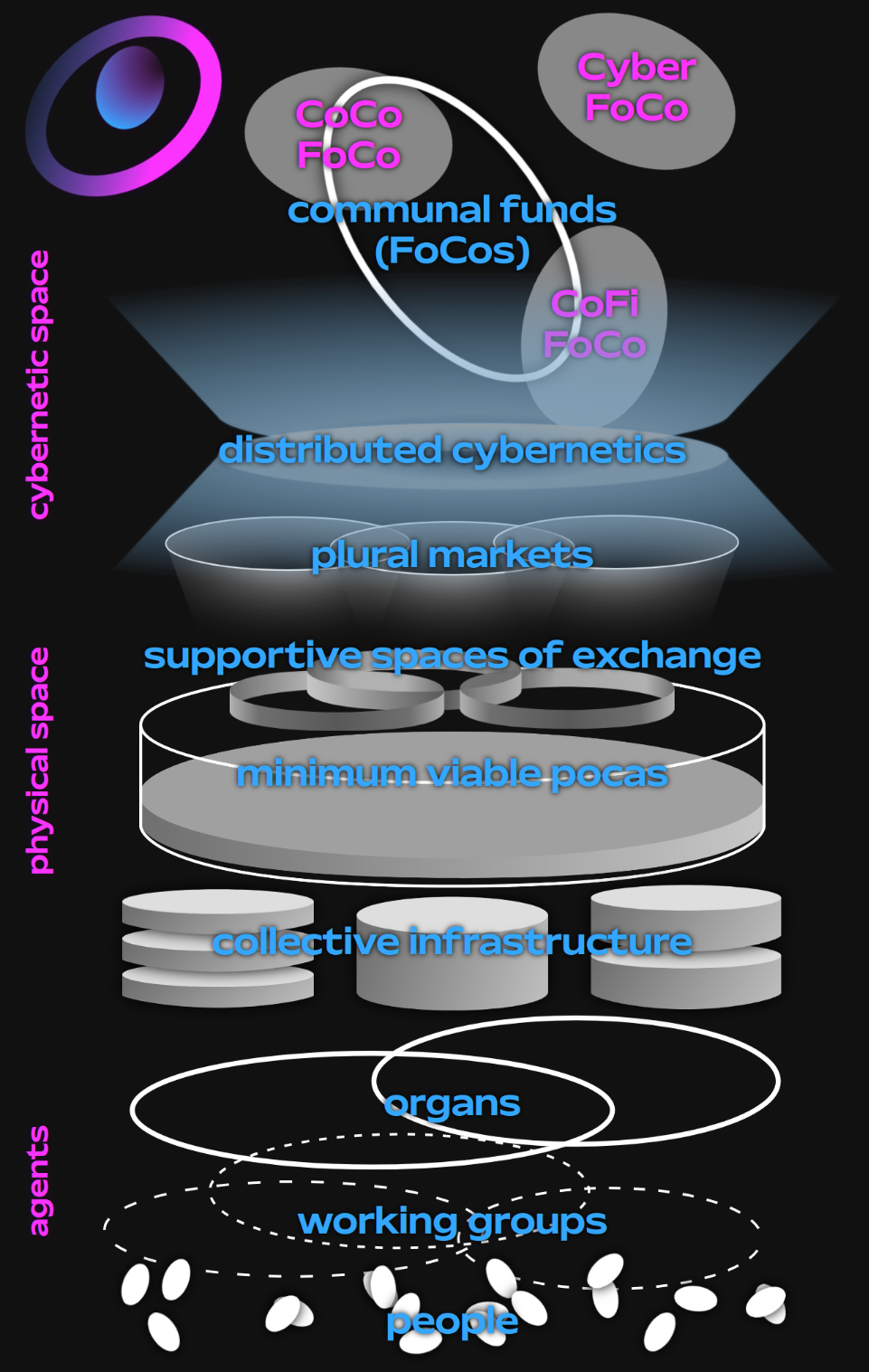
Pocas organizational diagram
Accessible generative AI, specifically diffusion models, boomed after the release of DALLE-2 by OpenAI in the spring of 2022\. As I was already working on this project, it quickly became an integral part of its production. These images not only hinted towards the post-capitalist alternative I was imagining, but they also did it in a very particular way: With its dream-like, synthetic, artificial look, these pictures were somehow very effective in communicating the speculative essence of the project. They look genuine at the first instant, but their veracity crumbles after a closer look. For this project, rather than a shortcoming, I saw this as a positive aspect. It creates a doubt in those who see the images and question their origin. Is this AI? Or is it a photograph of a real place? To me, that confusion becomes extremely productive, as by doubting their veracity, the spread between actual and potential is charted. Because these images feel real at first glance, it creates the possibility that these spaces and culture could be real.
Generating images with these kinds of prompts not only visually resembles recycling but also effectively acts as a form of it. (Albeit, not a very sustainable one considering the energy costs of running these models). The images are generated by taking what already exists within the data of the model and shaping it into a new form that is effectively different. By invoking “self-service convenience store”, in a prompt alongside a variety of alternative values and aesthetics, this acts in practice as a mutation of the aesthetics of convenience stores. It acts as a form of exploration of the latent space for alternatives. In a metaphorical sense, these spaces are not only present in the visual latent space of the model but they are also latent in our existing world. Pocas presents a vision where nothing is really new, but just a different arrangement of what already exists. It is for this reason that the generative AI models suit this project so well, both practically and conceptually.
As an art project, pocas leans on the resources, communities and networks of cultural spaces to become a no-compromise sandbox for thinking about how our most basic self-sustenance can be collectively organized. Through art and science-fiction, pocas wants to become a space of collective speculation where we can think beyond the legal framework encompassing permits, labor laws, financial regulations, and the judicial system.
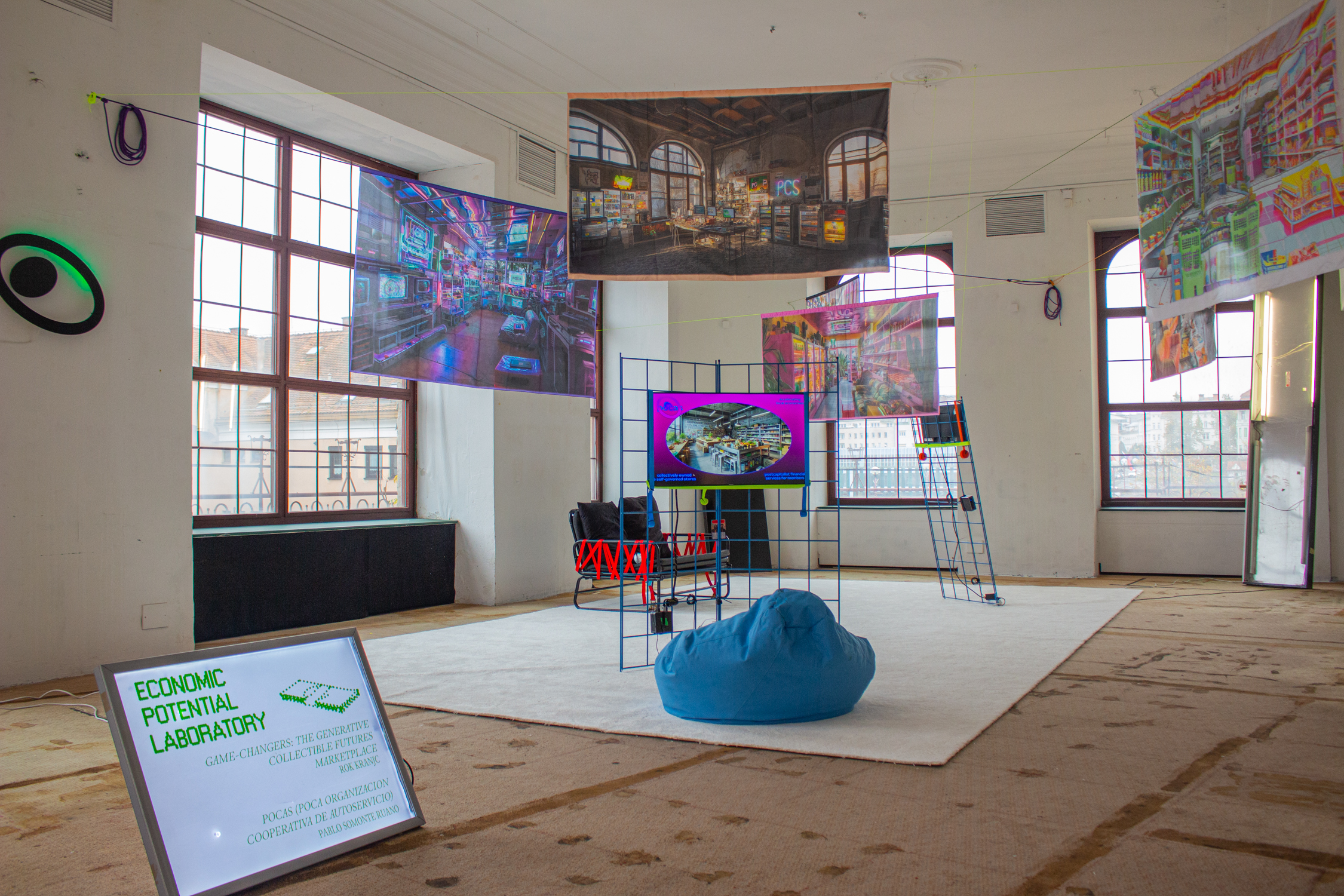
Pocas installation at the 30th Festival for Computer Arts Maribor, Slovenia (MFRU). Photograph by by Mitja Lorenčič
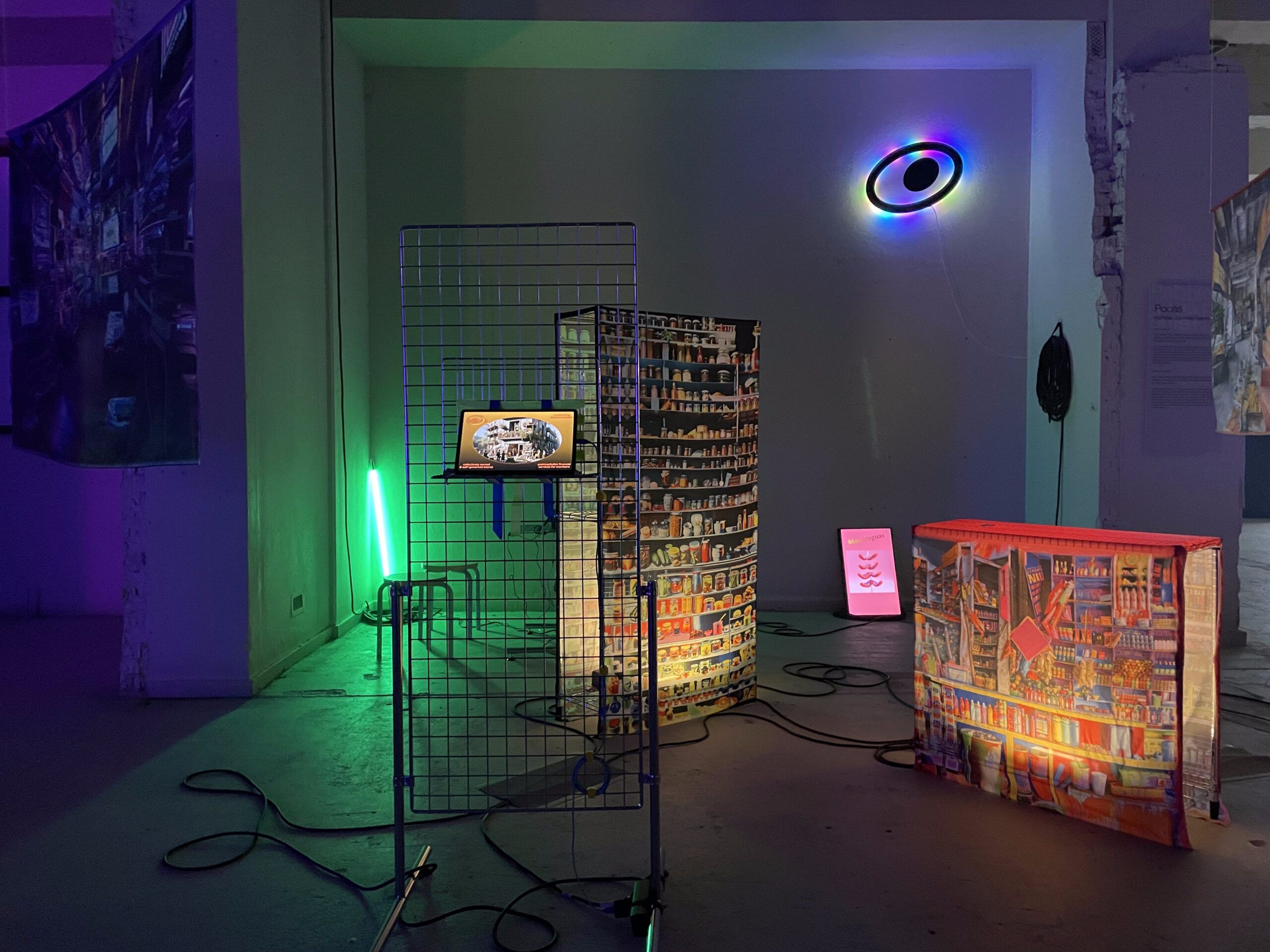
Pocas installation at the STRP Festival in Eindhoven, Netherlands as part of the works granted with the Award for Creative Technology (ACT 2024).
In this initial speculative stage, the project aims to present pocas as a credible large-scale mutualist alternative. The visual and conceptual presentation are intended to generate an affective response that speaks to both the familiar and the possible. In other words, it aims to produce a postcapitalist subjectivity that renders mutualist convenience as a credible possibility in the minds of visitors. In the future, pocas aims to continue collaborating with cultural spaces and groups with the purpose of prototyping, testing and co-designing its social and digital tools in conversation with others.
Visit https://pocas.store/ for more!