

Motion in Progress
Motion in Progress is a concept project in which I developed and tested both a wearable product and a technological idea for use in sports..
Abstract
Wearables have become an essential tool in sports. By capturing and analyzing biometric data, they enable athletes to design their training more precisely and effectively.
This study focuses on the development of an innovative wearable designed to support athletes in acquiring motor skills. The device aims to provide real-time tactile feedback to confirm the correct execution of an exercise.
To achieve this, theoretical foundations on motor learning, muscle memory, and the general use of feedback in sports were examined. Additionally, the concept was represented through the construction of a prototype. My Tests confirmed that the vibrations could be perceived and interpreted during a complex sports exercise.
Furthermore, interviews with four athletes were conducted to gain insights into learning new skills and overall training structures.

Theory
A fundamental aspect of many sports is the acquisition of specific motor skills—such as a particular jumping technique in basketball or a type of somersault in gymnastics. Learning such skills presents both cognitive and physical challenges, requiring a complex interplay of bodily processes to master them.
This learning process can be enhanced through improved feedback during training. Information about one’s own execution of an exercise is not only crucial for targeted training but also essential for learning movements correctly from the outset.
Muscle memory is considered the result of motor learning, where repeated movement strengthens neural connections and stores them long-term in the nervous system. It is particularly important to learn movements correctly from the beginning to maintain proper technique over time and avoid ingraining incorrect movement patterns.
To improve the learning of movements and promote the storage of correct movement patterns in muscle memory, I developed a real-time feedback system. This approach aims to ensure that the training flow remains uninterrupted while enhancing athletes’ focus during practice.
Technology
To test my idea, I used an Arduino Pro Micro and an IR remote to control a vibration motor.

During the design process and testing, a LiPo battery and a click switch were additionally integrated into the power supply of the Arduino to create a self-sufficient, mobile system that can be more easily attached to the body.
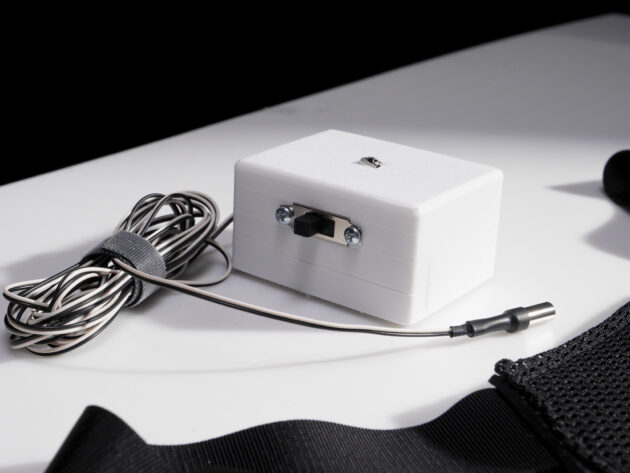
While testing, the technical parts had to be protected, so I created a 3D printed case with PETG, which is robust and waterproof.
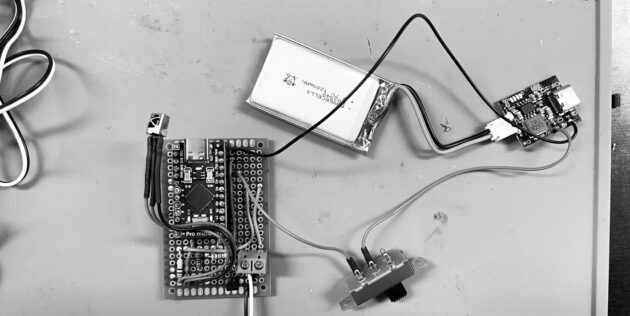
Testing_Prototyping
The initial rudimentary tests without a fully mobile system confirmed that athletes could, in principle, imagine wearing such a device during sports activities.

Additionally, the tests showed that the vibration could be perceived and interpreted during a complex exercise.
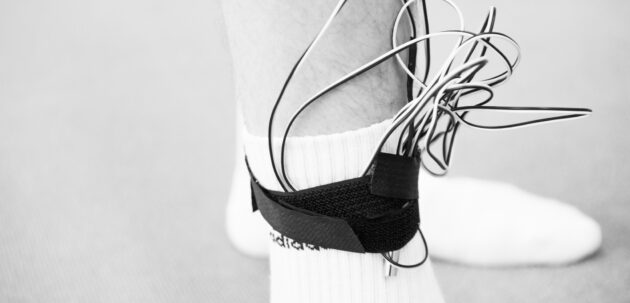
The test subjects suggested that, with sufficient experimentation, they might develop a sense of when the vibration occurs, helping them better understand when a movement is performed correctly.
Although the use of the IR remote limited the angle and distance during testing, it still provided valuable insights into the system’s usability.

For both stylistic and practical reasons, I decided to attach the prototype to the back of a vest.
Concept
The R.A.T. (Repetitive Adjustment Trainer) is designed to provide athletes with real-time vibration feedback to confirm the correct execution of a movement during training.
Using camera-based motion capture, the system compares the athlete’s movements with data from professionals and sends this information to the wearable on the vest. The movement is then evaluated within a set range between “correct” and “incorrect.” If the movement is correct, feedback is provided; if incorrect, no feedback is given.
The idea is that this system will strengthen the athlete’s intrinsic awareness of their movement in space and encourage experimentation. Achieving the reward can be seen as a form of search, where athletes develop an awareness of when the vibration feedback occurs, thereby recognizing when the movement is deemed correct.
In the future, the R.A.T. could be introduced to training studios, where it could be used in collaboration between trainers and athletes.
Until then, the system should undergo further testing, incorporating different vibration patterns, multiple vibration sources, or exploring alternative technologies to motion capture.
Acknowledgments
A heartfelt thank you to everyone who supported my project, especially my friends and family. I would also like to express my gratitude to Felix Fisgus and Qianxun Chen for their technical support.
Additionally, I would like to thank my supervisors Prof. Peter von Maydell and Prof. Dennis Paul for their support and great interest in my project, as well as the Hochschule für Künste Bremen, which made this journey possible for me.
Project developed in the Digital Media Program 2025
References
Muscle Memory:Pujari, V.: Muscle Memory and the Brain: How Physical Skills are Stored and Retrieved, J Adv Med Dent Scie Res, 2019, 7(9):273-279