

you are not doing amazing sweetie
hypervigilance & performance: perpetual self objectification as an internet ritual.
Since I can remember, I have always been bored.
When the computer and the internet came into my life,
they became my best friends. I was no longer alone, neither bored.
I was online, and there I multiplied.
I became me and many others.


you are not doing amazing sweetie is an auto-ethnographic research practice about existing online and
longing to belong. This thesis explores a tendency towards the objectification and sexualization of the
female body, turning it into a sculpture that never stops, feels nothing, never gets tired, and therefore
never fails.
(But at the same time, it never truly succeeds)
About finding oneself in pop culture, in the martyrs, in the
hyper-feminine woman who performs to validate herself in the face of the hyper-surveillance to which she
is subjected to and which she has adopted as her own behavior. Through an audiovisual installation & a
reading performance that delves into pre-AI digital twins, hypervigilance dynamics adopted from online rituals
and trauma bonding in online communities where perpetual self objectification becomes an internet ritual.


the process
- exert from CAPITULO 01 – Practice context & literature review
Using social media as a research ground and trauma as a topic, during my masters I continued my
research about image and the internet through hyperfeminine performance and how we navigate pain and
trauma in online communities, where women and queer people have created safe spaces for understanding
and recognition. Spaces where science, holistic methods, and mythology converge (Billuart, 2023) and
how women and queer individuals have been portrayed in media, and how this existence of women and
girls online under a patriarchal system is commodified and expression out of the male gaze becomes
monstrosity, and how existing in this conditions can become a normalized traumatic experience leading to
hypervigilance on the female body under its scrutiny on a constant basis.
- exert from CAPITULO 02 – Methodology / Artistic Approach
I engaged in different forms of embodiment and expressing, from classic drag to digital drag where I
played with the ambiguity of my look, from being a cis-gender latina woman to a fem-non-binary angel
that exists only online.
This practice shifted into a behaviour, one where I could not only see myself enjoying how I looked but
analyzing micro changes my face and body were going through, this turned into self tracking, feeling that
If I vigilate myself hard enough I will be able to stop the changes in order to stay ideal forever, it became
a ritual of me trying to keep up with the one I was presenting online. EXHAUSTING.


“the internet already is what it is. It has
already become the central organ of contemporary life. It has already rewired the brains of its users,
returning to a state of primitive hyperawareness and distraction while overloading us with much more
sensory input than was ever possible in primitive times. It has already built an ecosystem that runs on
exploiting attention and monetizing the self.” (Tolentino, Jia, 2019)
The more I embraced being online, the more I questioned it too, it started feeling like in the wake of all
celebrating being ourselves, we ended up being put into categories, into tags, #sadgirl #cleangirl
inhabiting also tagged places and ways of being #witchtok #oldmoney #tradwives. It felt like jumping
from one idea to the other without ever fully understanding who are we surrounded with for a minute, in
the economy of attention, where platforms make a profit of short attention span content. Being able to pay
attention is a luxury not everyone can afford and the more distracted we all are, the easier it is to alienate
us against ourselves.
(…)
In 2020, I was diagnosed with PTSD from undisclosed traumatic events, both officially by a licensed
psychotherapist as well as many online self assessment tests. Not only was I tracking my face online but
also my pain and problems, and then the internet looked back at me. For years tracked my searches and
listened to my conversations and when this became apparent, in 2022 it tried to sell me solutions.
Bombarded by ads, the internet alerted me that I was harboring trauma in my body, causing me to gain
weight. With a soft ASMR voice whispering in my ear, guiding and helping me, the internet explained
that I was unhappy not only because of unresolved trauma and PTSD, but also because my body, as a
self-defense mechanism, stored fat in my belly in order to survive, and it promised me that if I followed a
strict routine of exercises and a low calorie diet I would be cured and even more important, I would be a
hegemonic desirable woman of Instagram, I would be HOT.
The wound is not the end, it is the portal. The ritual is not just a gesture, it is reclamation. (Lynette, Otissia, 2025)
the performance
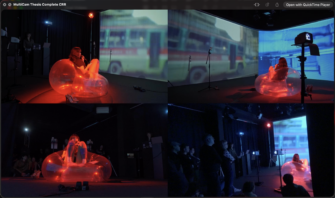
At 3:00 pm on April 7th 2026 at the Videostudio in Speicher XI at HFK Bremen I sat on a plastic
transparent inflatable chair. I faced two screens that surrounded me: on the left, a video I recorded in 2007
from the journey I used to take from my best friend’s place to my home by bus in Bogota, Colombia,
The screen on the right played a video archive of pole dance practices, showing over and over grip failure
and ankle twisting on Pleasers, a play between struggle & performative hyperfeminity.
At 3:15 pm both videos started playing simultaneously to a distorted ambient mixed audio (So Far Away
by Charlie XCX & Crude Drawing Of An Angel by Caroline Polachek) created by Aleksandra Mitrović.
As a bored child at a party, I sat on my plastic chair and I followed a score: like in a bubble, and I waited
until I reached home in my video and I glimpsed when I looked good on my pole practice and also when I
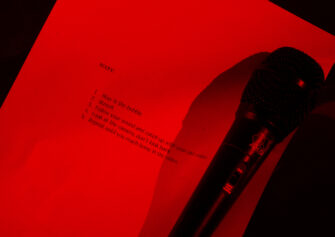
could have looked better. I stretched, and I kept waiting in my sad karaoke-like, reading the lyrics of the
song Crude Drawing Of An Angel by Caroline Polachek.
I repeated and repeated the song, and I let myself dissociate in my plastic chair bubble until I reached
home. All while I was being observed by an audience that could see me through two security cameras that
were aiming at me, vigilating my boredom.
This performance lasted 12:21 min, the approximate time that used to take me to move from my best
friend’s house to mine during high school when we lived at home in Bogotá before we both migrated to
Europe.
Bibliography
– Disidentifications, 1981 – José Esteban Muñoz
– Traumacore, 2023 – Núria Gómez Gabriel
– Simulacra and Simulation, 1983 – Jean Baudrillard
– Trick Mirror, 2019 – Jia Tolentino
– Cycles, the Sacred and the Doomed, 2023 – Morgane Billuart
– Becoming the Product: The Critical Internet Researcher as a Virtual Intellectual, 2025
– Morgane Billuart
– Down the drain, 2024 – Julia Fox
– Ways of Seeing, 1972 – John Berger
– Lacan’s Concept of Mirror Stage, 1949 – Jacques Lacan
– Fear of Being Seen: The Witch Wound and How to Heal It
A Therapeutic Essay on Visibility, Ancestral Surveillance, and Ritual Sovereignty by Otissia
Lynette.
referents ⋆。° ˖ ⊹⋆.˚
analivia cordeiro – daria blum – nina peters – julia fox – britney spears – sigrid lauren and monica mirabile – jennicam – rosalia – molly soda- arvida bystrom- dan graham – julie scher – valie export – pipilotti rist
Thesis Supervised by Dr.Prof Andrea Sick & Prof. Ralf Baecker
Sound Design by Aleksandra Mitrović
Set and Light Design by Arne Burhop and Alethia Pinzón Rodríguez
Photography and Video by Atticus Pinzón Rodríguez and Arne Burhop
Digital Media Graduation Festival 2026
Set Up/ MA Thesis Adaptation for Digital Media Graduation Festival.
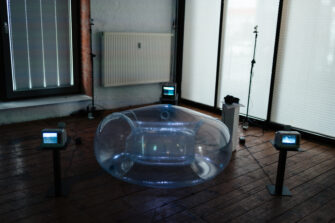


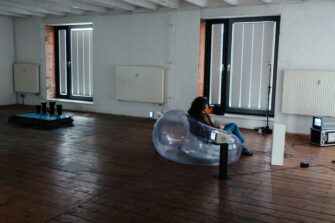
Photography by Jimi Liu.