

The Moderator: Thinking Before Answers
The Moderator is a working prototype for an AI interface that does not answer immediately. Instead of moving straight from prompt to output, it turns a question into a branching process of reflection. The system generates interventions that ask the user to challenge, reframe, associate, and clarify their own thinking before reaching a synthesis.

Start screen of The Moderator, showing a dark interface with a central prompt card that says “Begin with a question…”
The project explores a simple concern: when AI tools answer too quickly, they may also skip the slower human work that often happens before an answer. This includes questioning assumptions, making connections, tolerating ambiguity, and forming a position. The Moderator asks what an AI interface could look like if it helped keep that work visible.
The result is a speculative design prototype: part interface, part argument, part working question.
Context
This project was developed in the course Designing for Competencies, where the broader topic was competence loss in relation to AI systems. I became interested in a specific pattern in everyday AI use: the way many generative AI interfaces encourage users to move quickly from uncertainty to completion.
That speed is useful. It is often the reason these tools feel powerful. They help people write, summarize, decide, translate, plan, and produce. But in many creative and intellectual tasks, the answer is not always the most valuable part of the process. Something important can happen before the answer: the question changes, assumptions become visible, the problem becomes less obvious, and the user begins to understand what they are really asking.
The concern is not that AI gives answers. It is that repeated immediate convergence may reduce how often we practise the human work that happens before an answer.
The Moderator responds to this concern by making a different kind of interface. It treats a prompt not as an instruction to complete, but as a seed for exploration.
Working hypothesis
This project is a speculative design investigation based on course discussion, design observation, and limited secondary research. It does not claim to have validated a causal relationship between current AI interfaces and long-term competence loss.
The working hypothesis is:
If AI interfaces repeatedly move users from prompt to answer too quickly, users may have fewer opportunities to practise the competencies involved in open-ended thinking.
These competencies include:
- reframing a problem
- questioning assumptions
- making unexpected connections
- generating alternatives
- tolerating ambiguity
- articulating a position
The Moderator does not claim to solve competence loss. It asks what kind of interface might be designed if we take that possibility seriously.
What the prototype does
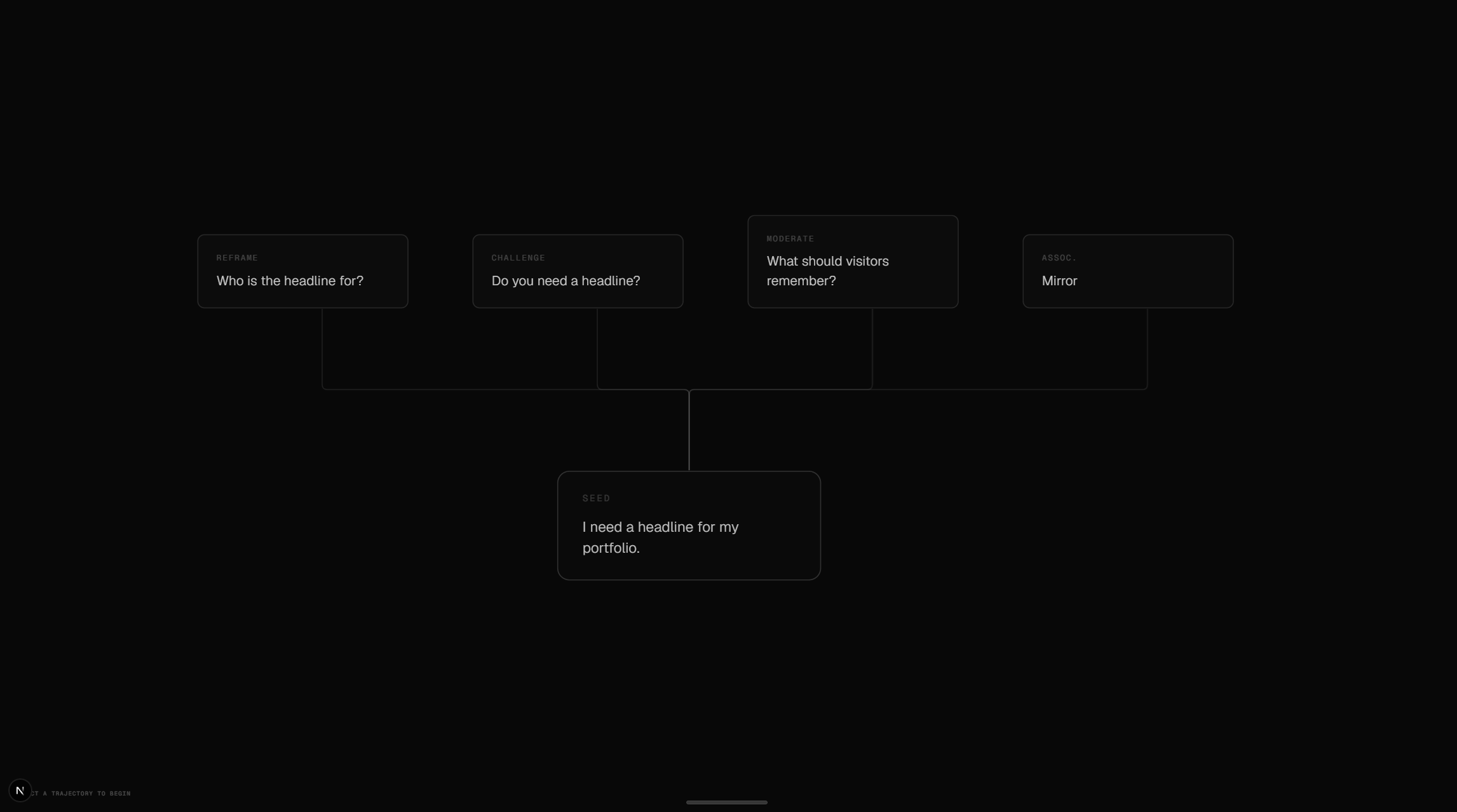
The initial portfolio prompt with four intervention nodes branching above it. The nodes are labelled Reframe, Challenge, Moderator, and Association.
The prototype begins with a user prompt. In the example used for this documentation, the prompt is:
I need a headline for my portfolio.
A conventional AI tool might respond by producing headline options. The Moderator does something else. It presents four initial interventions around the prompt. Each intervention represents a different way of opening the question:
- one might challenge the premise
- one might reframe the situation
- one might ask the user to clarify their intention
- one might create an associative connection
The user can open a node, read the provocation, and write a reflection. The tree does not grow by clicking alone. It grows only when the user contributes.
The system then uses that reflection to generate three follow-up nodes. These follow-up nodes respond to the user’s actual words, not just the original prompt. After three rounds of exploration, the system offers a synthesis that gathers the path together.
This makes the interface behave less like a machine for producing answers, and more like a moderator that keeps the question alive long enough for the user to think with it.
Interaction flow

An opened Challenge node asking “Do you need a headline?” with a reflection field below it.
The interaction follows a simple rhythm:
- The user enters a prompt.
- Four intervention nodes appear.
- The user opens a node and reads its provocation.
- The user writes a reflection.
- The reflection becomes a visible node in the tree.
- New interventions are generated from the reflection.
- The user continues through up to three rounds.
- The system produces a synthesis based on the explored trajectory.
The interface is intentionally visual. Reflections do not disappear into a chat thread. They become part of the structure. Unexplored branches remain visible, but dimmed, so the user can still sense the paths not taken.
The result is a visible record of movement: where the user began, which interventions they followed, what they wrote, and how the question changed.
Intervention types
The prototype uses four types of interventions.
Challenge questions the premise, assumption, or hidden contradiction in the prompt. It is often the most direct form of friction.
Reframe shifts the scale, audience, context, or meaning of the question. It asks the user to see the problem from another angle.
Association introduces a metaphor, image, memory, or sideways connection. It creates productive distance from the original task.
Moderator asks a clarifying or guiding question. It helps the user name what has changed, what matters, or what needs to be made more concrete.
These are not four answer categories. They are four kinds of pressure. Their purpose is not to solve the prompt immediately, but to disturb the first answer and make room for another thought.
Example walkthrough
The most useful test case was a simple portfolio request:
I need a headline for my portfolio.
At first, this looks like a copywriting task. A typical AI response would probably generate a list of polished headline options. The Moderator instead offered a Challenge node:
Do you need a headline?
The node asked what would happen if the first impression came from the work itself. That changed the task immediately. The question was no longer just “What should I say?” It became “What should the work make visible?”
The first reflection was:
Maybe I don’t need a clever headline. I need visitors to understand what kind of thinking my work shows.

A first reflection node appears in the tree, with new generated follow-up nodes above it: Naming the shift, Whose understanding matters, and Thinking made visible.
The next generated nodes responded to that shift. One of them asked whose understanding matters. This challenged another assumption: that the designer can fully control how recruiters interpret the work.
The second reflection was:
Maybe I’m trying to control how recruiters interpret me, when what I can actually control is how clearly I show the decisions behind the work.

A second opened Challenge node titled “Whose understanding matters” asks whether there is a part of the user’s thinking they do not actually want fully understood.
At this point, the request had moved from headline writing to interpretation, control, and evidence. The system then generated another set of nodes, including one about decisions and constraints.

A second reflection node is visible below three generated follow-up nodes: Same verb, moved target, Decisions or constraints, and The lab notebook.
The final reflection was:
Maybe I should show one decision together with the constraint that shaped it, so the portfolio does not just say I think clearly, it lets someone see the thinking happen.

The final reflection appears above the selected Reframe node, which now shows maximum depth reached.
The synthesis brought this path together. It noted that the user started with a headline and ended somewhere else, not away from the problem, but underneath it. One phrase from the synthesis captured the shift especially well:
From presenting yourself to exposing pressure.

The synthesis overlay summarizes the explored path through the three selected nodes and three user reflections.
This example shows the main value of the prototype. The system did not simply generate better copy. It helped reveal that the original request was carrying a deeper question about evidence, interpretation, and how design thinking becomes visible.
What the prototype demonstrates

A zoomed-out view of the full three-round tree, showing the complete explored path from seed prompt to synthesis.
The prototype demonstrates three ideas.
First, reflection can become interface structure. The user’s contribution is not hidden inside a conversation log. It becomes part of the visible system.
Second, AI can apply pressure instead of only producing solutions. The generated nodes challenge, reframe, associate, and moderate. They create conditions for thought instead of replacing it.
Third, synthesis can preserve a path rather than erase it. The final response does not pretend the answer appeared from nowhere. It is based on the route the user took and the shifts that happened along the way.
The zoomed-out tree is important because it shows the form of the thinking process. Not every piece of text is readable at that scale, but the structure remains visible: the seed, the branches, the reflections, and the final point of synthesis.
Technical implementation
The Moderator was built as a browser-based prototype using Next.js, React, and TypeScript. The branching canvas is structured around custom nodes, reflection states, and generated intervention layers.
The prototype includes:
- a three-round exploration limit
- four initial intervention nodes
- three generated follow-up nodes after each reflection
- visible reflection nodes
- maximum-depth states
- synthesis generation
- live AI follow-up generation
- a reliable mock fallback if live generation fails
- Zod validation for structured model responses
The system separates the interface from the generation layer. This means the front end does not directly depend on mocked content. The prototype can switch between mocked generation and live AI generation through a configuration layer.
The live AI layer is used for follow-up interventions and synthesis. The opening four nodes are predefined in the current version so the first interaction remains stable for demonstration and documentation. After the user writes a reflection, the follow-up nodes are generated live from that reflection and can vary from session to session.
The final submitted version was tested through linting, TypeScript checks, production build checks, and manual interaction testing. The final documentation version also received a visual polish pass for rounded corners, clearer borders, smoother node behavior, improved spacing, and cleaner screenshots.
Limitations
This prototype is a proof of concept, not a finished product.
The most important limitation is that it has not yet been tested through a formal user study. I cannot claim that the interface preserves or strengthens human competence. I can only show that the interaction model creates more space for reflection than a direct prompt-to-answer interface.
Other limitations include:
- The prototype currently supports only three rounds of exploration.
- The opening four nodes are predefined for stability, while follow-up nodes and synthesis are generated live.
- The project has been tested with a limited set of prompts.
- The synthesis can sometimes become too long or too analytical.
- There is no session persistence yet, so explorations are not saved after leaving or refreshing the page.
- The interface has not yet been tested with a broad range of users.
- The balance between productive friction and usability still needs evaluation.
There is also a deeper design question: how long should the system keep a thought open? Too little friction makes the interface feel like any other AI tool. Too much friction may become exhausting. The next stage would need to explore that balance more carefully.
Next steps
The next stage of the project would focus less on basic functionality and more on depth, guidance, and evaluation.
Possible next steps include:
- adjustable exploration depth, so users can choose how long to stay with a question
- branch merging, allowing two thought paths to be brought together
- session saving and export, so users can return to unfinished explorations
- more prompt categories, including creative, personal, research, and decision-making prompts
- warmer and more actionable synthesis
- clearer ways to return to the original question after a long associative path
- user testing to observe whether the interface changes how people reflect
- evaluation criteria for the quality of reflection, not only the quality of final output
During testing, the three-round limit was enough to demonstrate the interaction. But the experience often became more interesting as the path deepened. The next question is not simply whether more rounds are possible, but how much room a thought should be allowed to take before synthesis becomes useful.
Video documentation
The accompanying video demonstrates the interaction flow using the portfolio headline example. It shows the prompt, the first Challenge node, the user’s reflections, live-generated follow-up nodes, the final maximum-depth state, and the synthesis.
The video is intended to show what static screenshots cannot fully capture: the rhythm of the interface. The tree grows only when the user contributes.
Credits and tools
Project and prototype: Calvin Tettey
Course: Designing for Competencies
Lecturer: Peter von Maydell
Programme: M.Sc. Digital Media, University of Bremen
Tools and technologies used:
- Next.js
- React
- TypeScript
- Zod
- Anthropic Claude API
- Cursor
- Git
- DaVinci Resolve
All interface screenshots used in this documentation are captured from the working prototype. No stock imagery is used in the final documentation materials.
Closing reflection
The Moderator began as a response to a concern about competence loss, but the prototype became more specific than that. It is not a rejection of AI-generated answers. It is an attempt to design more space around them.
The project asks whether an AI interface can help users arrive at answers without skipping the thinking that makes those answers theirs.